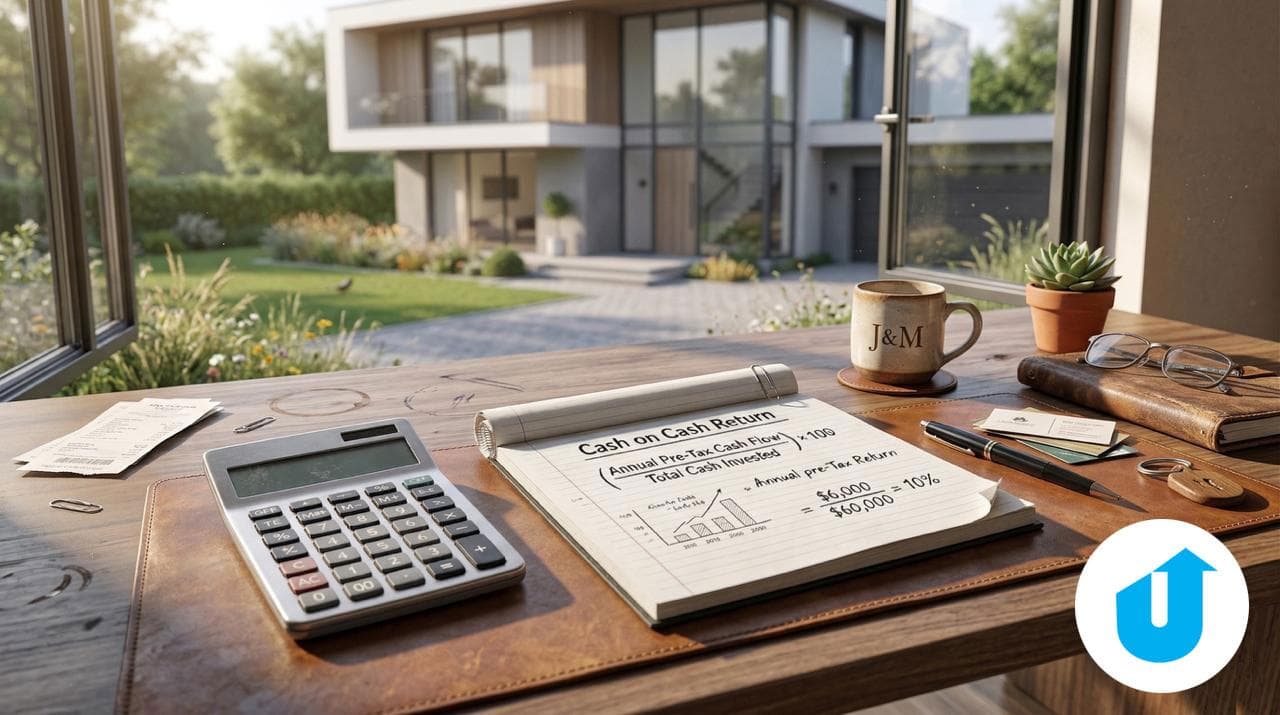
Cash on cash return is the single most important number in rental property investing. It's also the most commonly miscalculated.
Here's what it actually means, how to calculate it correctly, and what the number is really telling you.
The Formula
Cash on cash return = Annual Pre-Tax Cash Flow ÷ Total Cash Invested × 100
That's it. How much cash you make per year divided by how much cash you put in.
Example:
- You buy a rental property. Total cash out of pocket: $60,000 (down payment + closing costs + initial repairs)
- After all expenses (mortgage, taxes, insurance, management, maintenance, vacancy, CapEx reserves), you net $6,000/year in cash flow
- Cash on cash return: $6,000 ÷ $60,000 = 10%
Simple formula. The complexity is in getting the inputs right.
Where People Screw It Up
Mistake 1: Forgetting what "total cash invested" means
It's not just your down payment. It's every dollar that left your bank account to acquire and prepare the property:
- Down payment
- Closing costs (both sides if applicable)
- Inspection and appraisal fees
- Initial repairs and rehab
- Furnishing costs (if applicable)
- Any reserves the lender required
I've seen people calculate cash-on-cash using only their down payment. That's not the same number. A $50K down payment with $15K in closing costs and repairs means your total cash invested is $65K, not $50K. That alone can swing your return by 2-3 percentage points.
Mistake 2: Using gross rent instead of actual cash flow
Your cash flow is not your rent. It's your rent minus everything:
- Mortgage payment (principal + interest)
- Property taxes
- Insurance
- Property management (even if self-managing, budget it)
- Maintenance (8-12% of gross rent)
- CapEx reserves (5-10% of gross rent)
- Vacancy loss (5-8% depending on market)
The most common version of this mistake: forgetting vacancy. If you assume 0% vacancy, you're assuming a tenant pays rent every single month forever with zero turnover. That's not conservative. That's fantasy.
Mistake 3: Including appreciation
Cash on cash return measures cash flow. Period. It does not include property appreciation, principal paydown, or tax benefits.
Those things matter for your total return. But cash on cash tells you one specific thing: how hard is your actual cash working right now? Mixing in appreciation turns a cash flow metric into a speculation metric.
What's a Good Cash on Cash Return?
The honest answer: it depends on the market, the interest rate environment, and your alternatives.
Some benchmarks:
- Below 4% — You're taking on real estate risk for bond-like returns. Hard to justify unless you're banking on appreciation.
- 4-7% — Acceptable in expensive markets (coastal cities, high-demand areas) where appreciation potential is strong. Thin margins though.
- 8-12% — The sweet spot for most investors. Solid cash flow with room to absorb surprises.
- Above 12% — Either you found a great deal, or something is off in your assumptions. Double-check the numbers.
In 2026, with current interest rates, hitting 8%+ cash on cash requires either a strong market, a value-add play, or a larger down payment. The days of easy double-digit returns with 20% down are mostly gone in competitive markets.
A Real Example
Let's run a realistic scenario:
Property: 3BR single-family rental in a mid-market city
- Purchase price: $250,000
- Down payment (25%): $62,500
- Closing costs: $6,000
- Initial repairs: $4,500
- Total cash invested: $73,000
Monthly income:
- Gross rent: $1,900
Monthly expenses:
- Mortgage (P&I on $187,500 at 7%): $1,248
- Property taxes: $260
- Insurance: $130
- Property management (8%): $152
- Maintenance (10%): $190
- CapEx reserves (7%): $133
- Vacancy (6%): $114
- Total expenses: $2,227
Monthly cash flow: $1,900 - $2,227 = -$327
Cash on cash return: Negative.
Welcome to a lot of deals right now. That property looks great until you run honest numbers. The rent isn't high enough to cover conservative expenses at current interest rates.
Now change one variable. Raise the down payment to 35% ($87,500 + $10,500 closing/repairs = $98,000). Mortgage drops to $1,081/month. Monthly cash flow becomes $46. Cash on cash: 0.6%.
Still not great. This is why Phase 1 of any analysis — defining your thesis — matters so much. If your target is 8% cash on cash, this property was never going to get there. You'd know that in five minutes instead of five hours.
Why It Matters More Than Cap Rate
Cap rate tells you about the property. Cash on cash tells you about your investment.
Two investors can buy the same property at the same cap rate and have completely different cash-on-cash returns depending on their financing. The one who puts 40% down will have a higher cash on cash than the one who puts 20% down (lower mortgage payment = more cash flow relative to cash invested).
This is where it gets nuanced. More leverage = less cash invested = higher cash on cash if the deal cash-flows positively. But more leverage also means higher mortgage payments and thinner margins. The right answer depends on your risk tolerance and your cost of capital.
Cash on cash captures all of that. Cap rate doesn't.
Calculate It Honestly
We built UpsideHero to force honest inputs. It pulls real rental comps so you can't inflate rent, defaults to conservative expense ratios, and stress-tests the deal at -15% rent.
Run a property through it and see what your real cash on cash return looks like. Phase 1 is free.